

Your smartphone connects you to everything. It can also become your personal casino cage. That little rectangle in your pocket holds infinite possibilities—and infinite temptations.
Enter the casino self-exclusion app. This isn’t just tapping a button. It’s building digital guardrails against your own worst impulses. Think of it as the technological equivalent of locking the liquor cabinet, except the cabinet follows you everywhere.
Programs like TalkBanStop use a brilliant three-step process. They combine Gamban’s blocking technology with GAMSTOP registration. It’s digital mindfulness meets practical barrier.
The beauty? These tools leverage the very technology that enables mobile gambling to protect you from it. Your phone transforms from temptation machine to recovery tool. It’s the 21st century solution to an age-old human struggle.
Differences: site‑level vs operator‑wide vs national schemes
Think of self-exclusion like choosing your battlefield. Will you fight one app at a time? Or declare war on the entire industry?
Site-level exclusion is your tactical nuke. It blocks one specific gambling app or website. Quick to deploy. Easy to reverse. But let’s be real—it’s like locking your front door while leaving the back wide open.
Operator-wide schemes cover all platforms under one company’s umbrella. If you exclude from MGM, you’re blocked from their mobile app, website, and physical casinos. Smarter, but it’s not foolproof. What about their sister companies?
National schemes are the nuclear option. Programs like the UK’s GAMSTOP or Australia’s BetStop blanket every licensed operator in the country. One form. Total blackout. It’s like digital prohibition.
Europe shows us how cultural attitudes shape these systems. Sweden offers a minimalist one-month cooling-off period—barely enough time to miss your favorite slot machine. Spain demands a six-month commitment. Why the difference?
Regulatory maturity and technological infrastructure create this patchwork. Some countries treat gambling like a casual vice. Others see it as a public health crisis.
Operator tools provide immediate relief but come with compliance holes. Their terms of service read like a philosophy thesis crossed with a legal trapdoor. Ever tried unsubscribing from a mailing list? Now imagine that with your life savings at stake.
National schemes aren’t perfect either. They require government coordination and industry buy-in. But when they work? They’re the closest thing to a digital fortress.
The real question isn’t which option you choose. It’s how many layers of protection you need. Because in the world of mobile gambling, temptation is always one click away.
Step‑by‑step: enable self‑exclusion inside popular mobile casino apps
Finding self-exclusion in casino apps is like looking for an exit in Vegas. They must have one, but it’s hard to find. These apps hide their responsible gambling features deep, like hiding losses.
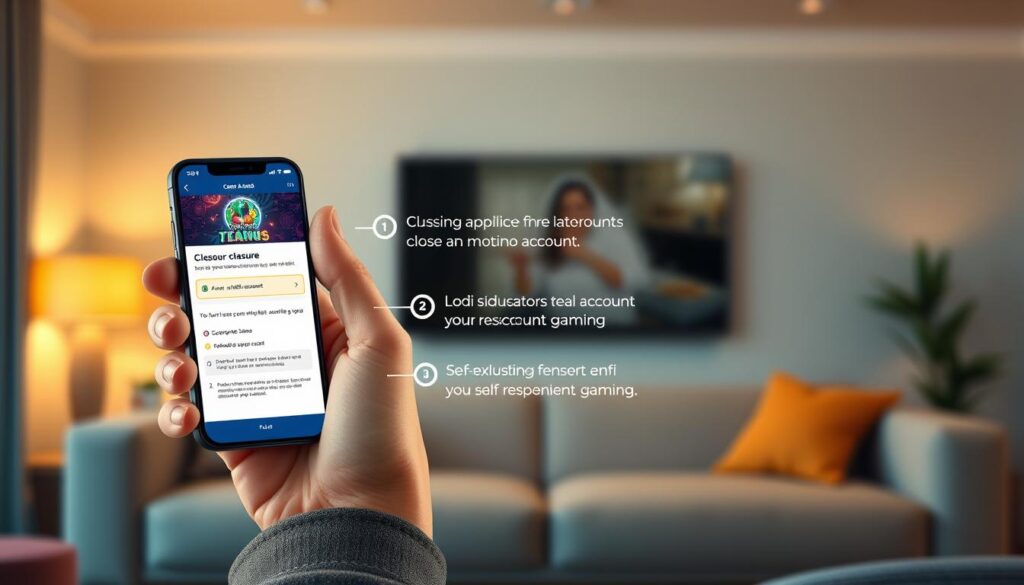
Let’s look at how big names handle self-exclusion. They seem to follow rules but don’t really want to. It’s like a teenager doing chores.
| Platform | Self-Exclusion Path | Cooling-off Period | Special Features |
|---|---|---|---|
| BetMGM | Settings → Responsible Gaming → GameSense → Self-Exclusion | 72 hours to permanent | Personalized timeout options |
| Caesars | Account → Safety Controls → Self-Ban | 1 month to 5 years | Multi-state exclusion sync |
| FanDuel | Profile → Responsible Play → Time Out | 7 days to 30 days | Real-time play alerts |
| DraftKings | Menu → Responsible Gaming → Self-Exclusion | 72 hours to indefinite | Deposit limit pre-screening |
| BetRivers | Account → Limits → Self-Exclusion | 1 week to permanent | Partial exclusion options |
FanDuel’s “Real-Time Check-In” is ironic. Your phone checks if you’re sure before you deposit. It’s like having a therapist who also runs the blackjack table.
The account closure process is interesting. Some apps make it easy—just three clicks. Others are harder than quitting caffeine. You’ll find yourself in more menus than a streaming service.
BetMGM’s GameSense program is unique. It tries to be both dealer and therapist. But finding self-exclusion tools is like finding Easter eggs.
Remember, these account closure tools vary by operator. It’s like blocking one dealer but leaving others. The steps usually include:
- Locating the “Responsible Gaming” section (often in account settings)
- Selecting self-exclusion duration
- Confirming your choice through email verification
- Receiving final confirmation of exclusion
Most platforms take 24-72 hours to process. During this time, you can access your account. It’s like a final temptation test.
The cooling-off periods vary. Some offer 72-hour timeouts to permanent account closure. Others make permanent exclusion hard to find.
These choices are not random. They show the balance between following rules and making money. Finding self-exclusion is an achievement.
iOS/Android device‑level blocks and profiles
Your smartphone secretly wants to be your therapist. It has wellness features to track screen time and block gambling. Think of them as digital bouncers that don’t care about your excuses.
Apple’s Screen Time is like having a personal assistant who says “no” to bad ideas. It’s not made by gambling companies. This means no conflicted interests—just setting boundaries.
Setting up a restricted profile for gambling apps creates distance. It’s like keeping junk food on the top shelf. Using parental controls on yourself is a sign of adulting.
Android’s Digital Wellbeing acts like a friend who takes your keys when you’ve had too much. The app timer feature sets hard limits. Sometimes, willpower needs a technological wingman.
Creating a separate user profile for entertainment is a smart move. Compartmentalization is not just for work—it’s for protection. Your gambling apps stay in one digital room, while everything else is clean.
The best part? These tools are already in your settings, waiting for you. They’re like discovering your phone is a recovery tool. It just needs you to press the right buttons.
Third-Party Blockers (Gamban, BetBlocker): Setup, Limits, Pros/Cons
Imagine digital bouncers who don’t work for the casino—no conflicted interests, no temptation to look the other way. That’s the beauty of third-party blocking software. These tools answer to you, not the house.
Gamban operates like that brutally honest friend who won’t let you text your ex. No matter how much you beg or rationalize, it stands firm. The setup? Surprisingly simple. Download, install, and watch as it paints gambling domains as digital no-go zones.
Then there’s BetBlocker—the Wikipedia of blocking tools. Open-source, community-supported, and completely free. It’s funded by donations, making it the people’s choice for digital restraint.

How do these digital guardians work? Some modify your host files like graffiti artists tagging gambling sites as “off-limits.” Others use VPN-style tunneling, rerouting your temptation through what amounts to a moral filter.
Let’s break down the key differences:
| Feature | Gamban | BetBlocker |
|---|---|---|
| Cost | Paid subscription | Free (donation-based) |
| Coverage | Thousands of sites | Global database |
| Device Support | Multi-platform | Cross-device |
The pros? They block thousands of sites comprehensively. No casino loyalty means no loopholes. These tools don’t care if you’re trying to access a betting site or read gambling news—they block it all.
The cons? It might feel like using a sledgehammer to crack a nut. You might lose access to legitimate financial sites or sports news portals that occasionally discuss gambling. It’s digital abstinence versus moderation, and these tools firmly choose abstinence.
Compatibility varies across devices. Most work on iOS, Android, Windows, and Mac. Some even offer browser extensions for added protection. The setup typically takes under five minutes—faster than ordering delivery.
These tools represent a fundamental choice in approach. They’re not about limiting your access to specific apps. They’re about creating a digital environment where temptation simply can’t reach you.
How to verify the block works
Trusting your self-exclusion tools is like trusting a parachute—you don’t want your first test to be during freefall. Verification isn’t paranoia; it’s practical psychology for the digital age.
The moment of truth arrives when you type that casino URL and… nothing happens. It’s the digital equivalent of trying a locked door. But sophisticated users need sophisticated verification methods.
- Test across multiple browsers (Chrome, Firefox, Safari)
- Attempt access from both mobile and desktop devices
- Check during different emotional states (because determination varies with mood)
- Verify after system updates or reboots
The technological verification involves understanding how these blocks work. Host file modifications mean checking your system files, while VPN-based solutions require testing different network connections.
Psychological verification is trickier. Wait for that urge to play and observe how the block holds. It’s quality testing for your willpower, with your financial wellbeing as the testing metric.
| Verification Method | What to Check | Success Indicator |
|---|---|---|
| Browser Testing | All installed browsers | Consistent blocking across platforms |
| Device Testing | Phone, tablet, computer | Uniform access denial |
| Network Testing | Wi-Fi vs cellular data | Block persists across connections |
| Emotional Testing | High-temptation moments | Block holds under pressure |
Multi-device blocking approaches like TalkBanStop’s system require thorough testing. The goal isn’t just to see if one door is locked—it’s to ensure every entrance is secure.
Remember: verification isn’t about doubting the technology. It’s about confirming your safety net exists exactly where and when you need it most. That moment when the block holds? That’s not frustration—that’s freedom working as intended.
Reversals, timelines, and what to expect
Ever tried to get back an embarrassing email? That’s what the reversal process is like. It’s where good plans meet harsh realities.
The digital world has three ways to prevent regret. Time-out features are like a quick break from social media. Full self-exclusion is more drastic. And some tools can block gambling transactions on your cards.
Timelines show the game of psychology at work. Some platforms offer instant reversals, like a quick fix. Others make you wait, like a timeout for grown-ups.
The best systems need human help. Imagine calling a customer service to undo your account closure. It’s meant to be a bit awkward, to make you think again.
What to expect? A process full of obstacles. Many confirmation screens and waiting times. Sometimes, you might even get counseling referrals. It’s not just rules—it’s science.
Compliance can be unpredictable. Big sites usually follow the rules, but smaller ones might not. The best defense is to use many systems together.
Cooling-off periods vary from 24 hours to months. Some exclusions are permanent, like throwing away your car keys. Once set, they can’t be undone.
This isn’t about punishing you. It’s about giving you time to think. The best designs make you pause and reflect.
Where to get help if urges persist
Sometimes, even the best app blockers can’t stop a determined mind. Your phone might be clean, but your brain keeps finding ways around it.
At this point, we move from digital fixes to real-life help. Self-exclusion tools give you a cooling-off period, but if urges keep coming back, you need more.
The National Council on Problem Gambling is like the CDC for betting addiction. They have the data and plans to help. Gamblers Anonymous offers support groups that are older than any app you have.
For family members, Gam-Anon has the guide you need to deal with addiction. And the 1-800-GAMBLER hotline is always there for you.
The 988 Suicide & Crisis Lifeline is a lifeline for when things get tough. Gambling problems can be severe, and sometimes you need someone to talk to who can offer real help.
These resources are the safety net when digital tools don’t work. The most important block is the one in your mind, not on your screen.
Leave a Reply