

Forget the velvet rope and the human dealer. In the digital casino, your new croupier is an algorithm. It doesn’t smile or wish you luck. It just executes.
I’m talking about those ubiquitous buttons: autoplay, turbo, and quick spin. Casinos market them as convenient features. Let’s be real. They’re tools of temporal compression, collapsing the anxious pause between your bet and its outcome to near zero. They cater perfectly to our culture of instant gratification—the same impulse that fuels endless scrolling and next-day delivery.
So, what’s the core function? It’s the mechanization of hope. With one click on a platform like Rapidcasino, you move from an active participant to a strategic overseer. You set your bet, choose to run up to 100 rounds (or until a bonus feature triggers), and let the Random Number Generator do its chaotic dance uninterrupted.
Turbo and quick spin are simply the gas pedal. They strip away the decorative animations, speeding the reel blur into a meaningless hum. It’s the difference between playing a piano and programming a player piano. The music happens, but you’re no longer touching the keys.
Key Takeaways
- From Player to Overseer: Autoplay settings transform your role, automating the spin process based on your pre-set rules.
- Time is the Currency: Turbo and quick spin modes eliminate waiting, catering to a shortened attention span.
- The Psychological Shift: These features fundamentally alter your relationship with the game, prioritizing efficiency over ceremony.
Set safe spin counts and loss caps
Think of autoplay as a deal you make with yourself, with escape clauses. It’s not just about setting it and forgetting it. It’s about adding your own exit strategies. This is where theory meets practical self-care.
Let’s talk about spin counts. Setting a limit, like 100 spins, is like planning a single shot in a movie. It’s a way to control how long you play. This simple step is your first defense.
The real smart move is the loss cap. It’s like setting a limit on how much you can lose, inspired by behavioral economics. It’s like having a friend hide your keys. You tell the app, “Stop if I lose $50.” This shows you’re in control, not weak.
Today’s apps, like Rapidcasino’s, include safety caps in their settings. You can set timers and spending limits. It can stop when you lose a certain amount or win big. This is smart because it helps you keep your wins.
How does this work? Autoplay becomes a disciplined, almost meditative activity. You play the game but stay safe. You save mental energy and focus on patterns, not just playing.
Consider wagering requirements, where you need to “wager the bonus amount 50x.” Safety caps are key here. They stop you from losing your balance in frustration. Instead, you play within safe limits.
| Cap Type | Primary Function | Strategic Benefit | Typical Setting |
|---|---|---|---|
| Spin Count Cap | Limits the total number of automated spins per session. | Enforces time-based discipline; prevents endless play. | 50, 100, or 200 spins |
| Loss Cap ($) | Stops play when a specific monetary loss is reached. | Protects bankroll; embodies the pre-commitment principle. | $20, $50, or 10% of session bankroll |
| Win Stop | Halts automation after a large win is achieved. | Secures profits; counteracts the “gambler’s fallacy” to keep playing. | Stop at 2x or 3x starting balance |
| Session Timer | Ends the autoplay session after a set number of minutes. | Promotes healthy play habits; integrates with daily routine. | 30 or 60 minutes |
Using safety caps makes you more than just a player. You’re like a pilot with a detailed plan. You’re in control, not just along for the ride. This is what sets you apart from casual players.
So, when you turn on autoplay, pause. Look beyond the ‘Start’ button. Your true power is in the ‘Stop’ conditions you set. Define your limits. That’s how you make autoplay a tool for fun, not a risk.
Match speed to game volatility
Using turbo on a high-volatility slot is like fast-forwarding through a thriller; you miss all the suspense and just see the carnage. This section isn’t about banning the gas pedal. It’s about teaching you to read a game’s stats like a seasoned film critic reads a director’s style, then choosing your playback speed.
Every slot has a personality, defined by two cold, hard numbers: RTP (Return to Player) and volatility. RTP is the theoretical long-term payback. Volatility is the swinginess—the size and frequency of wins. A high-volatility game is a blockbuster: long, tense buildups punctuated by massive, explosive payouts. A low-volatility game is a clever sitcom: steady, reliable laughs delivered in quick succession.
Here’s the analytical framework. Low-volatility, high-hit-frequency games are the natural habitat for turbo and quick spin. They are engineered for a steady, rapid-fire drip of small to moderate rewards. Engaging quick spin here creates a satisfying, rhythmic flow. It’s like listening to a tight pop song at the correct tempo—everything clicks.
Now, the warning. Crank up the turbo on a high-volatility masterpiece, and you’ve fundamentally broken the contract. You’re vaporizing your balance during the inevitable extended dry spells, while completely missing the slow-burn tension the game’s designers spent months crafting. It’s all payoff, no setup. A hollow experience.
How do you apply this? Use the built-in casino filters. Most modern lobbies let you sort by volatility and RTP. Seek out “Low” or “Medium” volatility titles when you’re in the mood for a fast, session-based grind. Save the high-volatility epics for when you have time, patience, and a budget to withstand the silence between symphonic movements.
| Game Volatility Type | Ideal Speed Setting | The Rationale & Player Experience |
|---|---|---|
| Low Volatility | Turbo / Quick Spin | High hit frequency means constant, small action. Speed matches the game’s inherent rhythm, creating an engaging, flow-state experience without rapid bankroll erosion. |
| Medium Volatility | Standard Spin with occasional Quick Spin | A balanced mix. Use standard speed to enjoy features, but engage quick spin during base game lulls to maintain pace. Offers the best of both worlds. |
| High Volatility | Standard Spin (Avoid Turbo) | The drama is in the anticipation. Turbo mode accelerates the dry spells, causing frustration and bankroll drain, while completely negating the thrill of the eventual, large win. |
Think of it as strategic pacing. Your need for speed is valid, but it must be paired with the right co-star. A deep understanding of mobile slot volatility is your script. The data from the lobby is your director’s commentary. Your finger on the turbo button is the final cut.
So, the next time you feel the urge to accelerate, pause. Ask yourself: “Is this game a slow-burn novel or a page-turner?” Your answer will tell you everything you need to know about when to punch it.
Battery/data considerations
Turning on turbo mode is like putting your phone’s processor on a treadmill—it burns through battery life fast. This isn’t just a small detail; it’s a big worry. We all want to get ahead digitally, but we worry about our phone running out of power.
Every fast spin and HD animation costs power. You’re trading energy for the chance to win big. I’ve seen my battery drop 20% in just one fast game session, like the Astroboomers Turbo slot. The question is, is the excitement of playing 500 spins per hour worth a dead phone?
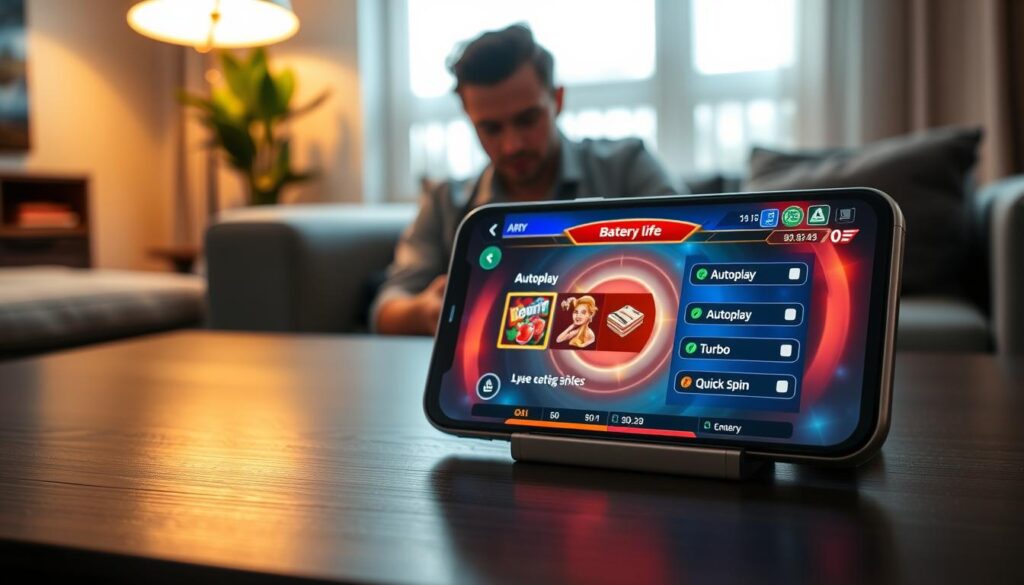
Smart developers understand this. They make games that use less power, like Rapidcasino. This means faster games and less battery use. It’s a key choice for players on the go.
Then there’s data. Without Wi-Fi, playing games can use a lot of your data. Every update and reward needs to go through the network. For smart players, managing data is part of the game.
Here’s the smart move: match your phone’s settings to your gaming goals. Turn down the screen brightness and close unused apps. On long trips, consider playing without turbo mode. It’s about endurance. You’re not just betting; you’re also making your phone last longer. Getting left with a dead phone is the worst loss.
Accessibility and one-hand play
The casino floor wasn’t made for people with arthritis. Your phone isn’t easy to use while doing other things. Features like autoplay and one-tap turbo are now key for everyone.
These tools are a game-changer for those with mobility or dexterity issues. They make spinning the reels easy, without needing to tap fast. It’s all about making things simple and accessible.
Let’s look at how these features work in real life:
- The commuter clinging to a subway pole with one hand.
- The parent with a child asleep in the other arm.
- The person simply wanting to enjoy a game without their hand cramping after 50 rapid-fire spins.
The “fixed footer navigation bar” is more than a trend. It’s a game-changer. It makes playing games easy, even with one hand.
Autoplay’s “spin intervals” setting is more than just timing. It’s about comfort and freedom. Longer spin intervals mean you can relax and do other things.
Autoplay with the right spin intervals makes games calm and enjoyable. It’s not just about speed. It’s about making games accessible to everyone.
These features make games fair for everyone. They recognize that we all have limits and busy lives. By making games easy to play with one hand, design is catching up with reality.
Responsible-use reminders
You’ve optimized the autoplay, engaged the turbo for thrill, and locked in quick spin safety nets. The machine purrs with algorithmic grace. But let’s ask the real question: when does efficiency become numbness?
The rhythmic automation of these features has a hypnotic quality. It can turn cash into a blur of digital points, quietly draining meaning from each bet. That abstraction is the silent tax of convenience.
This is where your strategy gets meta. The most critical turbo setting is your own off switch. Use session timers and loss caps not as suggestions, but as the non-negotiable architecture of your play. These quick spin parameters are tools for freedom, not traps.
Chasing losses is a story as old as gambling itself. A smart player uses autoplay to enjoy a predetermined session, not to dig out of a hole. It’s the difference between a curated museum tour and a frantic, lost sprint through its halls.
True control means viewing these settings as enhancements to your judgment, not replacements for it. For a foundational look at this ethos, consider the responsible gaming guidelines that prioritize healthy play and support.
The final analytical move is the simplest. It’s knowing the exact moment to stand up, pocket your phone, and reclaim your night. That’s the jackpot no algorithm can ever award you.
Leave a Reply