
Forget the noise of a live craps table. Forget the sticky floors and the groan of a seven-out. Your phone is the new felt. Mobile craps turns the casino into a private, strategic place. It’s not a watered-down version; it’s a focused, strategic sandbox.
This is where the real game starts. Without the table’s chaos, you face the game’s pure math. The frantic energy turns into calm analysis. This is your digital dojo for mastering the pass line and its shadow, the don’t pass line. It’s a place to learn about the odds bet, a zero-house-edge wager that casinos often hide.
Forget the tempting prop bets like the come bet and don’t come bet. True discipline is in the core bets. This guide focuses on the pass line, the genius of the free odds bet, and ignoring sucker bets. See your phone as a pocket casino, and you’re not just a player—you’re the house.
Layout in Mobile UI: Zoom, Highlights, and the Chip Tray
Forget the clatter of chips and the collective groan of a seven-out. In the mobile craps universe, your first challenge isn’t the point number—it’s the interface. You’re not at a physical table; you’re a trader on the digital felt, and your Bloomberg Terminal is the mobile app. The difference between a clean Bloomberg Terminal and the blinking madness of a 90s day trader’s screen is the difference between a disciplined strategy and chaotic, impulse-driven betting. Your success in mobile craps starts with mastering the interface before you place a single bet.
Mastering the Digital Felt
Think of the mobile craps interface as your command center. The felt is your trading floor, and every pixel has a purpose. A well-designed app, like a clean Bloomberg Terminal, presents data—in this case, betting options—with stark, unambiguous clarity. A poorly designed one looks like a ’90s stock ticker on a caffeine binge: all flashing lights and sensory overload designed to make you bet with your lizard brain, not your prefrontal cortex. The goal is to make the mobile craps interface work for you, not against you.
Your first power move is the zoom. That tiny “Place Bet” box for the 4 and 10 is a pixel-hunting nightmare on a small screen. Pinch and zoom. Get in there. A good zoom on craps table function is the difference between placing a smart 10 on the 4 and accidentally dumping your bankroll on “Any 7.” The best interfaces use subtle highlights or haptic feedback to confirm your tap. If you have to guess, you’re already losing.
This is where the “quick chips” feature, or the chip betting mobile tray, becomes your tactical dashboard. Don’t just tap the highest denomination. This isn’t a slot machine lever. The chip tray is your arsenal. A disciplined player uses the quick chips for rapid-fire, repeated bets—like a Pass Line with full odds. But the pro move? Use the custom chip value selector to size your bets to your exact bankroll strategy. Betting $6 on the 6 and 8 because the “quick chip” is $5 and you need $6? That’s an amateur move. Customize. Precision is power.
The chip tray is your tactical palette. A chaotic interface will scatter your chips haphazardly. A clean one groups them logically: Pass Line here, Come Bets there, Odds stacked neatly. It’s the difference between a Bloomberg terminal showing clean P&L and a Bloomberg terminal with 87 unread, blinking Bloomberg messages. One is a tool for making money. The other is a path to ruin.
Core Bets: The Unshakeable Foundation (Pass/Don’t Pass, Come/Don’t Come)
In the world of craps, your first choice is more than a bet—it’s a statement of belief. Every roll at the table starts with a choice: to support the shooter or oppose the table. This isn’t just about gambling; it’s a bet on your outlook on life. Are you optimistic or skeptical? The Pass Line and Don’t Pass Line are the core of craps, shaping your session. Understanding these bets is key to mastering the game. For more on strategy, check out Mari-Chaiv.
The Yin and Yang of the Craps Universe
The Pass Line bettor is always hopeful. They believe in the shooter and the dice, betting with the table’s energy. The Don’t Pass bettor, on the other hand, is cautious. They bet against the table, seeing the long game. The Don’t Pass has a low house edge, making it a smart choice.
These two bets are the core of craps. For every action, there’s an opposite reaction. They are the foundation, with all other bets built upon them.
Betting the Don’t Pass is a unique approach. While others cheer for a seven, you hope for a 7 to show up. It’s a strategic, almost meditative way to bet.
The Come and Don’t Come bets are strategic moves. They let you place new bets after a point is set. They’re for players who join the game late, adding strategy to your play.
Here’s the fundamental choice, broken down:
| Bet Type | You Win When… | You Lose When… | Philosophy |
|---|---|---|---|
| Pass Line | Shooter rolls 7 or 11 on come-out; or makes the point. | Shooter rolls 2, 3, or 12 on come-out; or 7s out. | The Optimist. Bets with the shooter and the table’s energy. |
| Don’t Pass | Shooter rolls 2 or 3 on come-out; or 7s out before making point. | Shooter rolls 7 or 11 on come-out; or makes the point. | The Contrarian. Bets against the table, the cool analyst. |
| Come Bet | Functions like a new Pass Line bet mid-game. | Same as Pass Line, but made after a point is established. | The Tactical Optimist. Gets in the game late. |
| Don’t Come | Functions like a new Don’t Pass bet mid-game. | Same as Don’t Pass, for latecomers. | The Tactical Contrarian. A cynical bet placed mid-game. |
Mastering these four bets is like learning chess basics. They are your foundation, with other bets being tactical moves. The key to the game’s best bet, the free odds bet, is built on this foundation. You need a Pass/Don’t Pass or Come/Don’t Come bet to place the coveted free odds bet, which has no house edge. This is the holy grail, the true “free odds” every sharp player seeks.
So, before you get lured by the center of the table, master this core. Are you a Pass Line optimist, riding the wave, or a Don’t Pass contrarian, playing the long game against the table’s emotion? Your answer defines your entire craps philosophy. For more in-depth strategy, the analysis at Mari-Chaiv offers a deeper dive into advanced craps tactics.
The Holy Grail: Odds Bets and Their Magical 0% House Edge
In the casino world, there’s a rare exception where the house doesn’t win. It’s the free odds bet. This is when the casino says, “This one’s on us.” It’s not a gift; it’s the casino’s way of saying the math is sacred.

The One “Free” Lunch in the Casino
The free odds bet is like the casino’s one “free lunch.” It’s a rare moment where the casino doesn’t try to make money. Craps, a game with roots in street dice, demands fair odds. The house edge is on the initial bet, but the odds bet is different.
It’s not kindness; it’s a necessary part of the game’s math. The casino is just playing fair on this one bet.
How to Bet the Odds (and Why You Must)
This is an arbitrage opportunity. You’ve made a Pass Line bet (with a 1.41% house edge). Then, you can place a second bet that pays true odds. The house edge on this bet? A perfect 0%.
The casino makes money on the initial bet. Then, they step back for the free odds portion. Bet the maximum odds your bankroll and the table limits allow. If the table offers “5x odds,” you can place an odds bet worth five times your original pass line wager. This is not a side bet; it’s the main event.
Think of it this way: the casino is the house, and they’ve rented you a room (your pass line bet) at a premium. The free odds bet is like they’re letting you rent the penthouse suite at cost. They’re not making money on the suite, but they’ve already locked you into the expensive room service.
The math is simple, beautiful, and non-negotiable. The table below shows why this is the only true “smart money” play at the craps table. The casino calls it “taking odds.” You should call it “taking what’s rightfully yours.”
| Point Number | True Odds Against | Payout on a $10 Odds Bet | Casino’s Edge on This Bet |
|---|---|---|---|
| 4 or 10 | 2:1 | Pays $20 (2 to 1 on your odds bet) | 0% |
| 5 or 9 | 3:2 | Pays $15 (3 to 2 on your odds bet) | 0% |
| 6 or 8 | 6:5 | Pays $12 (6 to 5 on your odds bet) | 0% |
Notice the beautiful, round, whole number payouts. No fractions, no rounding in the house’s favor. When the point is 6, and you have a $10 odds bet, you get paid exactly $12 when it hits (6 to 5 odds on a $10 bet: $10 * 6/5 = $12). This is the casino’s one concession to mathematical purity. It’s the one bet where the felt is level, and the only thing you’re fighting is variance, not the house.
So, the next time you’re placing a pass line bet, remember: the real action, the *smart* action, is lurking behind it. It’s the only bet in the casino where the house has no mathematical advantage. Not taking full odds isn’t just suboptimal; it’s leaving the one free lunch in the casino untouched on the table.
The Place/Buy/Lay Triad: Picking Your Spots with Precision
If the Pass Line is your steady, reliable 401k, and the Odds bet is your high-yield bond, then the Place/Buy/Lay complex is your options trading desk. This is where you move from broad market plays to tactical, high-precision wagers. Think of it as moving from index funds to a day-trading terminal. You’re not just betting on the dice; you’re managing a portfolio of positions on specific numbers. This triad of bets—Place, Buy, and Lay—gives you the scalpel to dissect the craps table with surgical precision.
Place Bets, Buy Bets, and Lay Bets Demystified
Let’s cut through the jargon. These three bets are your specialized tools for when the dice are hot and you want to concentrate your firepower. They’re the difference between lobbing a grenade and using a sniper rifle.
Place Bets: The Index Fund. This is your vanilla, no-frills wager on a specific number (4, 5, 6, 8, 9, or 10) to be rolled before a 7. It’s simple, it’s straightforward, and the house edge is a modest 1.52% on the 6 and 8, and a slightly steeper 4% on the 5 and 9. Think of it as a blue-chip stock: reliable, low-cost, and a core holding in any diversified craps portfolio.
Buy Bets: The Leveraged ETF. You’re placing a wager on a specific number (4, 5, 6, 8, 9, or 10) to hit, but you’re paying a 5% commission (the “vig”) upfront for the privilege of getting true odds. This is your leveraged ETF—higher possible return, but with a management fee. You’re buying a better payout, but the house takes its cut of the action off the top. It’s for when you have a strong conviction and want the maximum return on a single number.
Lay Bets: The Short Sale. This is where you play the contrarian. You’re not betting a number will hit; you’re betting it won’t be rolled before a 7. You’re “laying” odds that a 7 will show up before the chosen number. It’s like short-selling a stock you think is overvalued. The risk is higher, the mechanics are more complex, but the payoff for correctly calling a cold streak can be substantial.
When to Use Each (And When to Walk Away)
This isn’t about picking the “best” bet. It’s about choosing the right tool for the dice’s current mood. Use this as your field guide.
| Scenario | Your Move | Why It Works | When to Walk Away |
|---|---|---|---|
| The Table is Hot: A shooter is on a tear, rolling for 15 minutes without a 7-out. | Place Bets on 6 & 8. | Lowest house edge (1.52%) on the most common numbers. It’s a low-cost way to ride a hot streak without the vig of a Buy bet. | When the 7 inevitably comes. Walk away from the Place bets on the 7-out. |
| You’re Playing a Hunch: You have a strong feeling about a specific number (like a 4 or 10). | Buy the 4 or 10. | You pay the 5% vig to get true odds (2:1). On a $20 Buy bet on the 4, you win $40 minus the $1 vig. Your $20 Buy bet on the 4 wins you $39 ($40 win – $1 vig). | When the commission (vig) is more than 5% of your bet, or the table is cold and numbers aren’t hitting. |
| The Shooter is Icy: The dice are cold, and 7s are coming fast. | Lay the 4 or 10. | You’re betting a 7 comes before a 4 or 10. It’s a contrarian, defensive play. You’re the person selling insurance at the craps table. | When the shooter gets hot. Laying bets against a hot shooter is a quick way to donate to the table. |
| You Want Coverage: You want action on multiple numbers but don’t want to Buy them all. | Place Bets on 6 & 8. | You get the most frequent non-7 numbers covered with the lowest house edge. It’s the core of a solid, defensive craps portfolio. | When the point is 6 or 8. Don’t place a bet on the point number itself (that’s what your Pass Line bet is for). |
The matrix is your cheat sheet. A hot, consistent shooter? Your place bets on 6 and 8 are your best friends. See a shooter who can’t find a 4 to save his life? That’s a Lay bet whispering your name. But remember the golden rule of all markets: know when to walk away. If you’ve tripled your Place bet on the 6 and the table goes cold, take the win and press your luck another day. The dice have no memory, but your bankroll does.
In the end, the Place/Buy/Lay triad isn’t about finding a “sure thing.” It’s about understanding the probabilities, the cost of doing business (the vig, the house edge), and applying the right tool for the current moment. It’s the difference between a gambler and a player. One rolls the dice. The other makes the dice work for them.
Prop Bets: The Siren Song of the Center of the Table
The center of the table in your mobile craps game is very tempting. It’s like the casino’s gift shop, designed to catch your eye. The proposition, or “prop,” bets like Any 7 and Hardways are there. They are meant to make you think you can win big with just one tap.
This is where strategy goes out the window, and the casino makes more money. The house’s profit margin grows as you fall for these bets.
Buying a timeshare from a guy in a gold chain on the Vegas strip is like it. The promise is huge, but the house edge is hidden in the fine print.
Why the Glittering Center Bets Are a Tourist Trap
These bets are the casino’s clever trick. While you place your Pass Line and Come bets, your eyes wander to the center. The high-payout boxes there look like the main event but are just a side show.
They are like the overpriced souvenir shop at the theme park exit. The casino wants to take your money with a smile. The psychology is simple: high risk, high reward. But in craps, this is a financial trap.
The Cold Math of Terrible Odds
Let’s look at the math without hope. The house doesn’t rely on luck; it’s all about probability. A Pass Line bet has a house edge of just 1.41%.
But the bets in the center are different. Here’s the truth:
| Bet | Payout | True Odds | House Edge | The Sage’s Verdict |
|---|---|---|---|---|
| Any 7 | 4 to 1 | 5 to 1 | 16.67% | The sucker’s special. The “Any 7” bet is the casino’s best friend. |
| Hard 8 (or any Hardway) | 9 to 1 | 10 to 1 | 9.09% – 11.1% | A sucker’s bet masquerading as a smart play. |
| Any Craps (2, 3, or 12) | 7 to 1 | 8 to 1 | 11.1% | A long-odds bet that loves to eat bankrolls for breakfast. |
| Hop Bet (specific doubles) | 30 to 1 | 35 to 1 | 16.67% | Pure, unadulterated lottery ticket. The “house edge” here is your enemy. |
See the pattern? The rule is simple: If the payout is huge and glittery, your internal alarm should be screaming. A good rule of thumb: if a bet pays more than 10-to-1, it’s a red flag. The house edge on these bets is usually 9% to 16.67%.
While a Pass Line bettor fights a strategic battle with a low house edge, the prop bettor plays a carnival game. The house edge on these bets is the casino’s main income. They are the casino’s profit center for a reason. They are entertainment, a small wager for a thrill, but not a strategy.
In the craps table economy, the center is a tourist trap. The smart player keeps their distance, their chips on the outside where the math favors them.
Bankroll Ramps: Scaling Your Bets Like a Pro
Forget the myth of the hot hand; smart craps is a game of dynamic resource management. Your bankroll isn’t a static pile of chips—it’s a strategic reserve to be deployed with the precision of a general moving troops. This isn’t about superstition; it’s about constructing a financial fortress, brick by disciplined brick. A “bankroll ramp” is your personalized strategy for scaling your bets in response to the table’s energy, not your gut feeling. Think of it as your personal monetary policy, shifting between defensive austerity and calculated expansion.
Cold Table Strategy (The Defensive Stance)
When the dice are cold and the 7 is a frequent, unwelcome guest, your strategy must be one of capital preservation. This is the financial equivalent of playing the “prevent defense” in football. Your goal isn’t to win big; it’s to lose as little as possible while staying in the game, waiting for a better opportunity. The strategy here is minimalist and patient.
Deploy the bare minimum. Your core position should be a Pass Line bet with single or double odds. That’s it. This is your anchor. Avoid the siren song of the center table. The 7 will come, and it will eat your Place and Come bets for breakfast. Your only job here is to preserve capital. Think of it as a financial hunker-down, waiting for the economic indicators (the dice) to show signs of life. This is not the time for heroics. As the source data wisely notes: “If you said you’d only lose $50, stick to that. Losing is part of the game. Chasing losses is a spiral.” This is the defensive mantra.
Hot Table Strategy (The Controlled Offensive)
When a shooter gets hot, the energy shifts. This is your signal to shift from defense to a controlled offensive. The goal is no longer just preservation; it’s about capitalizing on variance while managing risk. This is where dynamic resource management kicks in.
Start with your foundation: a Pass Line bet with full odds. You have a working number. Now, it’s time to ramp up the pressure. This is where the come/don’t come bets become your best friends. Each time the shooter makes a point, you have a choice: let it ride or press. The disciplined approach is to press your winnings systematically.
The Aggressive, But Disciplined, Offensive
A hot table is the perfect environment for come bets. As the shooter continues to roll, you can place a come bet, effectively getting a new point every time you place one. This “works” more numbers for you, increasing your probability of winning on every roll. The ramp here is about using your winnings to finance expansion. A common ramp on a hot table might look like this: Start with a Pass Line bet with single odds. On the next point, use a portion of the winnings to place a Come bet. If that wins, use the winnings to take odds on that Come bet or place another number. You’re not just betting more; you’re building a network of active, working numbers, all while the original pass line bet chugs along. This is the “ramp”—a structured, incremental increase in your action that is funded by the table’s momentum, not your original bankroll.
| Strategy | Table Condition | Core Bet | Mindset | Risk Level |
|---|---|---|---|---|
| Cold Table (Defensive) | Frequent 7-Outs, Short Rolls | Pass Line with 1x-2x Odds | Capital Preservation | Low |
| Hot Table (Controlled Offensive) | Hot Shooter, Long Rolls | Pass Line, Full Odds, Come Bets | Controlled Aggression | Moderate to High |
The key is that your ramp has a pre-defined off-ramp. You’re not just betting more because you’re winning; you’re scaling your position in proportion to your growing, protected profit. If the shooter sevens out, you’ve locked in a profit from the ramp-up phase. This isn’t chasing; it’s momentum investing with a clear exit strategy. It’s the difference between a gambler and a strategic player: one is at the mercy of the dice, the other uses the table’s energy to build a structured, profitable exit.
Pace Control: Taming the Mobile Craps Beast
In a live casino, the game’s pace is intense. The dice roll fast, chips clatter, and the pressure is high. Mobile craps gives you control over time. This isn’t just a convenience; it’s a superpower that can change your game.
The Zen of the “Roll Toggle”
First, use the animation toggle. It’s like a meditation app. Turning off the animations helps you focus on the game’s math. You’ll see the numbers and bets clearly, making it easier to strategize.
Then, there’s “entertainment mode.” Turn the animations back on for fun. This mode is for enjoying the game’s excitement. The key is to be intentional about when you want to enjoy the game and when to focus on strategy.
Why Fast Play Can Cost You
Online, you control the pace. The “Snooze Button” is your “Roll” or “Deal” button. It’s your chance to think strategically.
Is the shooter on a streak, or are you impatient? The “roll” button is a chance to reflect. Ask yourself if your bets are sound or if you’re just chasing a win. Mobile craps helps you avoid impulsive betting.
Think of it as your morning alarm’s snooze button. It gives you a moment to think before acting. In craps, that moment is key to discipline. You’re not just betting; you’re strategizing. The screen is your command center. Next time, pause before betting. Your table and bankroll will appreciate it.
The Session Math: Rolls, Budget, and the Art of the Exit
The house edge is a rule, but your bankroll is yours. The difference between a fun night and a bad wallet often comes down to session math. It’s not about luck; it’s about planning. Forget luck. Your first step is to calculate, not bet.
From Bankroll to Bet Sizing: The 5% Rule
Think of your bankroll as an army. You wouldn’t send all troops to one battle. The 5% rule is your strategy. It means your max bet should be 5% of your bankroll.
Here’s the session math made easy:
- Session Bankroll: This is the money you can lose without worry. It’s not for rent or vacation. It’s for fun.
- The 5% Rule: Divide your bankroll by 20. This is your max bet per decision.
Example: You start with a $100 bankroll. $100 / 20 = $5. Your max bet should be $5. This is your bet sizing rule. It’s not a suggestion; it’s your safety net.
The 5% Rule and the Art of the Graceful Exit
Knowing when to leave is a key move many players miss. They’re like guests who don’t know the party’s over. A good exit strategy is your secret weapon.
This is where stop-loss and win goal limits become your allies.
- Stop-Loss (The Line in the Sand): Set a loss limit before betting. A common limit is 50% of your bankroll. Losing $50 on a $100 bankroll? You’re done. This is a smart exit, not a loss.
- Win Goal (The Graceful Exit): This is the real power move. Set a win goal, like 50% of your bankroll. A $50 profit on a $100 bankroll is a big win. Leaving at this point is how you win the game, not just a round. The casino fears the player who wins small and leaves.
The “Cash Out” button is not a sign of weakness; it’s a sign of strength. It’s you saying, “My math is better than yours.”
Mobile-Specific Safety & Etiquette (Even in Your Pajamas)
Mastering dice on your phone is more than just knowing the odds. It’s about managing the interface and your connection. Playing on a small screen with distractions nearby needs discipline. This is where the Sage player stands out from the amateur.
Think of your phone as a pocket-sized casino. The etiquette isn’t about saying “please” and “thank you” to a screen. It’s about respecting the unique pitfalls and protocols of the mobile interface. A fat-finger tap can cost you a fortune, and a dropped connection can feel like a roll of the dice with your bankroll. Here, wisdom isn’t just in the bet, but in the interface.
Quick-Cancel, Network Stability, and Confirming Your Roll
The mobile craps table is a marvel of modern convenience. But it removes the tactile feedback of a physical casino. You can’t just nudge a chip back across the felt with your pinky. That’s why understanding the app’s safety net is your first line of defense.
Playing it Safe: From Wi-Fi to Bankroll
Your first line of defense is your connection. A spotty connection isn’t just an annoyance; it’s a direct threat to your bankroll. Placing a bet only to have the app freeze or disconnect is the mobile equivalent of a dealer scooping your chips into the void. A stable, private Wi-Fi network is your best friend. Using mobile data? Make sure you have a strong, consistent signal. Treat a dropped connection like a “no-roll” at a live table—pause, and don’t place a bet until you’re reconnected and the app has fully synced.
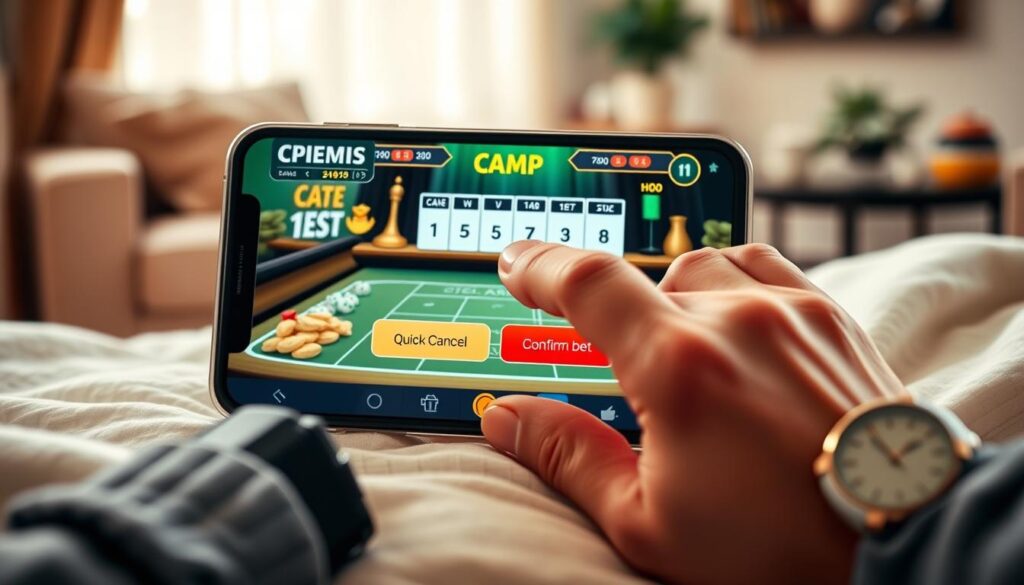
The genius of a well-designed mobile craps app lies in its “undo” functions. The Quick-Cancel button is your digital safety net. Mis-tapped a chip on the 12? A good app will give you a precious few seconds to hit “undo” or “cancel” before the bet is locked in. This is your “fat-finger insurance.”
Even more critical are the confirmation screens. A “Confirm Bet” pop-up after you place a wager is not a suggestion—it’s a final checkpoint. This is your last chance to confirm the bet type, amount, and odds. A “Confirm Roll” or “Roll the Dice” button is the ultimate gatekeeper. It prevents an accidental roll when you’re just trying to zoom in on the table. This isn’t just a feature; it’s your shield against costly, mindless taps.
The Sage doesn’t fight the interface; they master it. They know that the three seconds it takes to confirm your roll can save a stack of chips. They treat their connection stability as part of their bankroll management. After all, the smartest bet in the world is worthless if it gets lost in the digital ether.
| Mobile Hazard | Sage-Like Mitigation | Sage’s Pro Tip |
|---|---|---|
| Fat-Finger Bets | Use the “Quick-Cancel” or “Undo Bet” feature that appears for 2-3 seconds after placing a bet. | Always review your bet slip in the betting area before the timer runs out. |
| Accidental Roll | Always wait for the “Confirm Roll” or “Roll Dice” confirmation screen. | Treat the “Roll” button like a loaded gun; never rest your finger near it. |
| Unstable Connection | Only play on a stable, private Wi-Fi network or full 4G/5G signal. | If the connection lags, stop betting. Wait for the app to fully sync before continuing. |
| Battery Drain | Low Power Mode can throttle your device. Ensure your phone is charged or plugged in. | Gaming is resource-heavy. Close other apps and notifications to keep the app stable. |
Ultimately, the Sage understands that mobile craps isn’t just a game of chance, but a game of control. Control over your taps, your connection, and your confirmation screens. You’re not just betting on the roll; you’re managing a sophisticated, pocket-sized casino. The true discipline isn’t just knowing when to bet the 6 and 8, but knowing how to navigate the app so you can place that bet with confidence. That’s the difference between playing mobile craps and playing it smart.
The Mobile Craps Cheat Sheet: TL;DR for the Smart Player
Let’s get straight to it. You’ve learned the basics and now you need a quick guide. This is your essential cheat sheet for playing smart on your phone. It’s a quick summary of what really matters.
The “Do This, Not That” of Mobile Craps
Smart craps means betting with math, not against it. This cheat sheet helps you play smart quickly. Keep it handy for easy reference.
| Smart Play (Do This) | Sucker Play (Not That) |
|---|---|
| Pass Line/Come Bets with Max Odds: The foundation. It offers the lowest house edge and a “free lunch” when you take full odds. | Any Hardway Bet After the Point is Set: Betting on a 7 not showing for a specific number combo. The dice don’t care. |
| Place the 6 & 8: After a point is set, the 6 and 8 are frequent winners. They’re key in place betting. | Big 6/Big 8 or the “Any 7”: These bets have a huge house edge. The “Any 7” bet hurts your bankroll the most. |
| Come Bets on a Hot Roll: Use Come bets with full odds when the table is hot. It’s like having multiple lines in the water. | Proposition Bets (Hardways, Hop Bets, Horn Bets) for “Insurance”: They’re like lottery tickets, not strategy. The center of the table is a bankroll graveyard. As the Wizard of Vegas forums show, the math is against you. |
| Control Your Pace: Use the roll toggle. Breathe. The app won’t rush you. Your bankroll will thank you. | Chasing Losses with Prop Bets: Betting more on a “sure thing” in the center is a one-way street to losing all your money. Discipline is your only edge. |
Your Pocket-Sized Strategy Card
This is the essence of smart play. The house has an edge, but we can minimize it. Stick to the smart plays, manage your bankroll wisely, and know when to stop. Mobile craps is about playing the long game and making the math work for you. Now you have the cheat sheet. The rest is up to the dice.
Leave a Reply