
Remember when mobile gaming was just Snake on a Nokia? We’ve made huge progress. Now, the excitement of a live casino fits in your pocket. You can experience the green felt, card flips, and a dealer’s focus on a small screen.
Today’s live dealer blackjack is a mix of strategy and quick thinking. It’s not your old-school game; it’s a modern, high-tech challenge. You’re not just playing cards. You’re also dealing with the screen, speed, and betting psychology.
This guide is your expert in mobile blackjack. We’ll cover the basics and blackjack variants you’ll see. We’ll also talk about UI tricks that can affect your game. You’ll learn about tools like the Blackjack Trainer 101 app and the Mensa Guide.
This isn’t just about knowing when to hit or stand. It’s about mastering the live dealer blackjack interface and understanding different blackjack variants. You’ll learn to make quick, smart decisions. Let’s dive into the world of 21st-century blackjack.
Variants & Rules: decks, S17/H17, DAS, surrender
Think of blackjack variants like different ways to speak the same language. The goal of hitting 21 is the same everywhere. But the local rules make each game unique. This is your first step in strategy before betting.
In the mobile world, you can switch between games quickly. From a 3D single-deck game to a live dealer Atlantic City table, fast. Knowing these rules is key, not just for fun but for winning.
Understanding the Rulebook Before You Bet
Before the glamour of the game, learn the rulebook. The house edge changes with different rules. Use apps like Blackjack Trainer 101 to practice these rules.
Consider the dealer’s soft 17 rule. This rule is a big decision. S17 means the dealer stands on a soft 17, while H17 means they hit. This small change can affect the house edge by 0.2%.
Splitting and doubling are also key. Can you double down on any two cards? Can you Double After Split (DAS)? Surrender is also important, giving you a chance to fold a bad hand.
Here’s how different rules can change your game:
| Rule Variation | What It Means | Impact on Player | Strategy Insight |
|---|---|---|---|
| Dealer Hits Soft 17 (H17) | Dealer must hit on a soft 17 (Ace-6). | Increases house edge by ~0.2%. | Be more conservative with doubling and splitting. Surrender 15 vs. Dealer 10. |
| Double After Split (DAS) | You can double your bet after splitting a pair. | Significant player advantage. | Always split Aces and 8s. More aggressive splitting is optimal. |
| Late Surrender | Forfeit half your bet to fold a bad hand. | Reduces the house edge by ~0.08%. | Surrender hard 15 or 16 vs. dealer 9, 10, or Ace. |
| Single Deck | Game played with one deck. | Massive advantage for card counters; very rare in live dealer. | Deviate from basic strategy more often based on deck composition. |
| 6 vs. 8 Decks | Number of decks in the shoe. | More decks slightly increase house edge. | True count in card counting is less volatile with more decks. |
The live dealer blackjack experience is a test of your knowledge. You play against a real dealer, not a random number generator. The rules are fixed for that table. Your job is to find the best table for you.
Before playing live dealer blackjack, do your research. A game with S17, DAS, and surrender is different from one without. Your first move is choosing the right game.
Quick-Use Basic Strategy Charts for Phone Screens
Those days of fumbling with a plastic card are over. Now, your phone screen is your strategy card. The mobile blackjack strategy is about quick access to the chart. It’s about having information that helps you win, right when you need it.
At a live casino, using a crib sheet is frowned upon. But on your phone, it’s a smart move. The best mobile blackjack strategy tools adapt to your game. They’re like a GPS for your blackjack journey.
Your Pocket-Sized Strategy Coach
Modern apps turn your phone into a mentor. The Blackjack Trainer 101 app is a great example. It offers a “Hint” button that explains your play. This turns a simple chart into a learning tool.
Your strategy chart needs to be fast, like a dealer’s shuffle. You don’t need the whole basic strategy matrix on your phone. Just the key decisions that make you hesitate.
An effective mobile chart focuses on high-stakes decisions. It helps you decide between a 16 and a dealer’s 10, or whether to split 8s against a 7. It’s the difference between a guess and a strategic play.
Side Bets: The Alluring, Overpriced Candy Store
Side bets in blackjack are like a neon-lit stand next to a fine restaurant. They’re easy to find on mobile devices, promising quick wins. But, they have bad odds, making them a trap set by the casino.
Before you click, know this: side bets are like slot machine side games. They’re a distraction tax, as some smart folks say. While main blackjack games can have a low house edge, side bets are much riskier.
The Siren Song of the Side Bet
What draws you in? It’s the dream of quick, big wins. The chance to get a flush or straight with 21+3 or a perfect pair with a small bet is tempting.
But, let’s talk about the RTP (Return to Player). Main blackjack games have a low house edge, but side bets are much worse. A 21+3 bet can have a house edge of 3-7%. Some bets are even worse. Playing these bets is like playing a game you’re less likely to win.
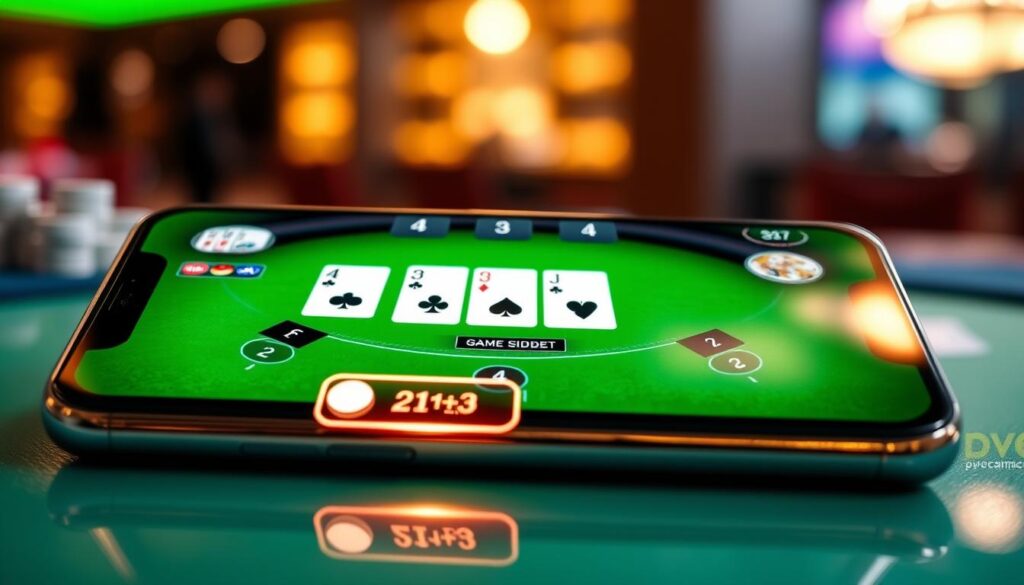
On mobile, it’s easy to make a mistake. A single tap can add a side bet to your wager. This ease is a danger, making it simple to bet more without thinking.
So, what’s the best approach? My advice is simple: If you can’t quickly calculate the house edge, don’t place the bet. View side bets as a small thrill, not the main part of your game. They’re like candy, tempting but not good for your strategy.
Seating & Bet Behind: latency, quick decisions, table selection
In a physical casino, picking a seat is about comfort and seeing the action. On your phone, it’s a strategic move with time pressure. It’s not just finding an empty spot; it’s about managing data, latency, and other players.
Your first choice isn’t at the table; it’s in the lobby. You’re not just looking for an open seat; you’re searching for a stable game. A table with a 2-second delay can make a simple strategy decision risky. That half-second delay between your action and the dealer’s can feel like forever when your money is at stake.
The Virtual Felt: Navigating the Digital Lobby
Choosing the “best seat” isn’t about the view of the dealer. It’s about the connection. You’re picking a data stream, not just a chair. A table with high video quality and low latency is more valuable than any seat at a slow table. The smart player focuses on a stable stream over a better table minimum.
The “Bet Behind” feature changes the game. It lets you bet on another player’s hand. It’s a way to play at a “full” table, but it’s risky. You’re betting on someone else’s strategy, which could be good or bad.
Before using Bet Behind, watch the player you’re betting on. See if they make smart decisions. If not, your bet is at risk. It’s a big trust issue with a stranger.
Here’s a quick guide to what you’re looking for when you “select your seat” in a digital lobby:
- Connection Stability Over Glamour: A stable 480p stream is better than a 4K stream that buffers. Lag is the true house edge in mobile play.
- Observe Before You Bet Behind: Lurk. Watch the player’s decisions for a few rounds. Are they a robot following basic strategy or a wildcard? Your money is riding on their next move.
- Table Minimums & Your Bankroll: A table with a $5 minimum and a $10,000 limit has a different vibe than a $100-minimum high-roller table. The betting behavior—and the speed of play—will be drastically different.
- Dealer Speed: A dealer with a brisk, consistent pace keeps the game moving and your attention focused. A slow dealer can be agonizing on a small screen.
| Seat Position | Latency Check | Player Vibe Check | Best For |
|---|---|---|---|
| Seat 1 (First Base) | May have slight audio/video sync delay. | Often more conservative players; sets the table pace. | Players who want to act first and set the tone. |
| Seat 3 (Third Base) | Often has the most stable stream as the “anchor.” | Often more aggressive; makes final decision before dealer. | Analytical players who want to see all cards before acting. |
| Bet Behind (Virtual Seat) | Dependent on the main stream. | You are at the mercy of the player you bet on. | Observers who want action at a “full” table. |
Your seat choice in a mobile live dealer experience is less about physical position and more about your position in the data stream and the social contract of Bet Behind. Choose your seat—and who you bet behind—with the same care you’d use to choose your bets.
Counting vs. Continuous Shuffles: why edge is negligible
Forget what you think you know about card counting from movies. In mobile blackjack, the deck is always shuffled. The idea of tracking cards to win, seen in films, doesn’t work in today’s mobile casinos. Here, the house always changes the game after each round.
The Card Counter’s Mobile Nightmare
Many players dream of beating the system with math. Books like the Mensa Guide to Casino Gambling teach complex counting methods. But in mobile games, this math doesn’t work because of modern casino tech.
This is a nightmare for card counters. The continuous shuffle machine (CSM) or the fast, deep-shuffled eight-deck shoe in digital games makes counting useless. Every hand, the count starts over, making it hard to track card ratios. Counting cards on mobile is like trying to count raindrops in a storm.
Apps like Blackjack Trainer 101 focus on basic strategy. They know that in mobile games, knowing the basic strategy chart is key. The Mensa Guide’s advanced methods are like blackjack calculus, but a continuous shuffler makes them useless. The house has effectively locked the vault.
So, what’s left for mobile players? Focus on the basics that do work on small screens:
- Perfect Your Basic Strategy: This is essential. Apps are designed to teach it.
- Forget the Running Count: The deck is shuffled too often and too well for a “true count” to be accurate.
- Play the Player, Not the System: Use your mental energy on bankroll management and table selection, not on a counting system that can’t win.
In the end, the “edge” a counter seeks is lost to the RNG of digital shoes or the CSM’s efficiency. Your mental energy is limited. On mobile, it’s better spent on mastering basic strategy charts in your app than on a counting advantage that the game’s design blocks.
Bankroll & Ramping for Mobile Pace (1–2% Units)
Your bankroll is key in mobile gaming, and managing it well is critical. Mobile gaming makes every break a chance to gamble, turning your phone into a casino. This ease can lead to overspending, as money seems endless on a screen.
The 1-2% unit rule is essential for mobile play. It protects your money from quick losses.
Protecting Your Stack in the Palm of Your Hand
The small screen in your hand can be addictive. Real money blackjack mobile play is fast, making it hard to stay disciplined. Betting 1-2% of your bankroll per hand is a must.
On mobile, a session can end quickly. A few taps can wipe out weeks of savings. This makes discipline vital.
Think of your bankroll as a sandcastle. Each bet is a wave. The 1% rule is your sea wall. If your bankroll is $1,000, bet $10-$20 per hand.
The Blackjack Trainer 101 app helps track your wins and losses. You’ll see that losing streaks are common. With a 1% unit, you can survive them. But with a 2% unit, you risk losing 20% of your bankroll in just ten hands.
Ramping up bets after a loss is tempting. But it’s dangerous on mobile. The “double your bet” button is just a tap away. It can quickly turn a bad session into a disaster.
Set a unit size at the start and stick to it. Whether you’re winning or losing, keep your bets the same. The Mensa Guide to Casino Gambling teaches this important rule.
Here’s a practical breakdown of how to structure your bankroll for mobile play. Mobile play is a series of quick sessions, not a long marathon.
| Bankroll Size | 1% Unit Size | 2% Unit Size | Recommended Session Time | Risk Profile |
|---|---|---|---|---|
| $500 | $5/hand | $10/hand | 15-20 min | Conservative |
| $1,000 | $10/hand | $20/hand | 20-30 min | Moderate |
| $2,000 | $20/hand | $40/hand | 30-45 min | Aggressive |
| $5,000 | $50/hand | $100/hand | 45-60 min | High-Risk |
The larger your bankroll, the more a 1% unit can be a big bet. But the risk of losing it all is lower. The mobile environment is distracting, making it easy to lose track.
This table is your battle plan. If you play real money blackjack mobile during your commute, bet 1% of your bankroll. For longer sessions, you might bet 2% but only if your bankroll can handle a 10-hand losing streak.
Protecting your bankroll on mobile means being disciplined. Your phone is a casino, and discipline is the only way to keep your money safe. Set your unit, set a time limit, and stick to the math. Mobile blackjack is thrilling but also risky. Manage your bankroll carefully, like it’s the last bit of battery on your phone.
Misclick Prevention: confirm toggles, portrait/landscape tips
In the world of mobile blackjack, the biggest challenge isn’t the dealer. It’s your own clumsy thumb. A simple mistake can change a win into a loss quickly. It’s not just about strategy; it’s about mastering the interface.
The pros don’t just play cards; they play the interface too. They use every tool to make sure their moves are correct.
Fighting Fat-Fingered Fiascoes
Imagine the panic when the dealer shows a 5 and you have a hard 16. The “Double” and “Stand” buttons are close together on a small screen. The pros don’t rely on luck. They start by checking the game settings.
They turn on every confirmation toggle they can find. This is the key to avoiding mistakes.
This is the most important mobile blackjack strategy tip for playing on devices. Apps like Blackjack Trainer 101 have a safety feature. They add a delay or require a tap for big actions like “Double” or “Split.”
This isn’t a bug; it’s a feature to protect you. Use these toggles to avoid costly mistakes.
Your device’s orientation is also important. Portrait mode is good for quick, one-handed play. But for serious sessions, landscape is better. It lets you see the whole table, track the shoe, and manage your chips better.
Think of it like this: use portrait for a quick game while waiting in line. Use landscape for a dedicated session where you can see everything. This is your mobile blackjack strategy for spotting patterns.
So, treat your phone like a physical table. Don’t slam your chips down carelessly. Toggle confirmations, choose your screen orientation wisely, and play with precision. The game is tough enough without fighting your own device.
Connection Stability: auto-rejoin, audio levels
In live dealer blackjack, your internet connection is key. A dropped packet can mean a lost hand. A frozen screen can bust your bankroll.
Before the game starts, your connection is your first bet. A slow stream in the live dealer experience is a big problem.
The Invisible Opponent: Your Internet Connection
Your router is like the dealer. If it hesitates, you lose. A lag or freeze can hurt your bankroll.
Top mobile casinos have auto-rejoin features. They keep you playing even when your connection drops. This is a big deal for your live dealer experience.
Good connection means more than just staying online. It’s about feeling like you’re there. Can you hear the dealer clearly? See the cards dealt smoothly?
Test your connection like you would a strategy. Start with a free table. See if you can follow the action without any issues. Your goal is a smooth, uninterrupted live dealer experience. In digital casinos, your internet is your most important chip.
Safer Play & The Practice Path: RNG app → live low stakes
Starting your blackjack journey doesn’t have to be expensive. It’s like a free digital training session. Your phone is your teacher, and the first lesson is free.
Use an app like Blackjack Trainer 101 as your practice space. It’s like a virtual dojo. Practice basic strategies until you can make decisions without thinking. It tracks your progress, helping you improve without spending money.
The Final Exam: The Live Table
Once you’re good at the simulator, it’s time for the real thing. Look for a live dealer table with the smallest bet. Your aim is to apply your skills in a live game, not to make money.
This isn’t just about playing games; it’s a structured learning path. Your phone helps you start with a simulator and then connects you to real live blackjack. When you’re ready, explore trusted platforms to test your skills.
Leave a Reply